
Participatory design brings communities together, influences social capital
Read the paper: Salinger, A., Charles, I., et al. 2024, World Development

Summary
By Allison Salinger
Social capital can be thought of as the shape and function of a person’s network or relationships within a community, including their participation in groups, relationships with leaders, perceptions of trust, belonging, and norms within that community.
Improving sanitation requires collective action; the majority of residents in a community must all use improved sanitation in order for any one of them to see health benefits. Social capital is a ‘catalysing ingredient’ that can enable people to come together and act at a community level to improve sanitation.
Evaluations of community-based sanitation interventions show that communities that start off with more social capital tend to be more engaged in program activities, and have better program outcomes, both in terms of toilet construction and behaviour change.
With this in mind, is it possible for intervention activities introduced early in the program cycle to intentionally bolster social capital? We evaluated the effect of participatory design and community engagement activities on social capital among urban informal settlements in Suva, Fiji and Makassar, Indonesia enrolled in RISE.
We found that participatory design and community engagement was positively related to social capital in Indonesia and negatively related in Fiji. The observed positive relationship in Indonesia is encouraging. And while there are several possible explanations for the negative effects observed in Fiji, the results point to the need for practitioners to carefully consider the social dynamics of communities they intend to work with to optimize program outcomes and avoid unintended consequences.
RISE has produced a series of publicly available, evidence-based resources: a toolkit and policy brief that aim to help WASH professionals and policy-makers do just that. The toolkit includes methods and approaches for assessing context (with a particular focus on gender and social inclusion) to inform the design of inclusive water and sanitation projects in urban informal settlements around the world.
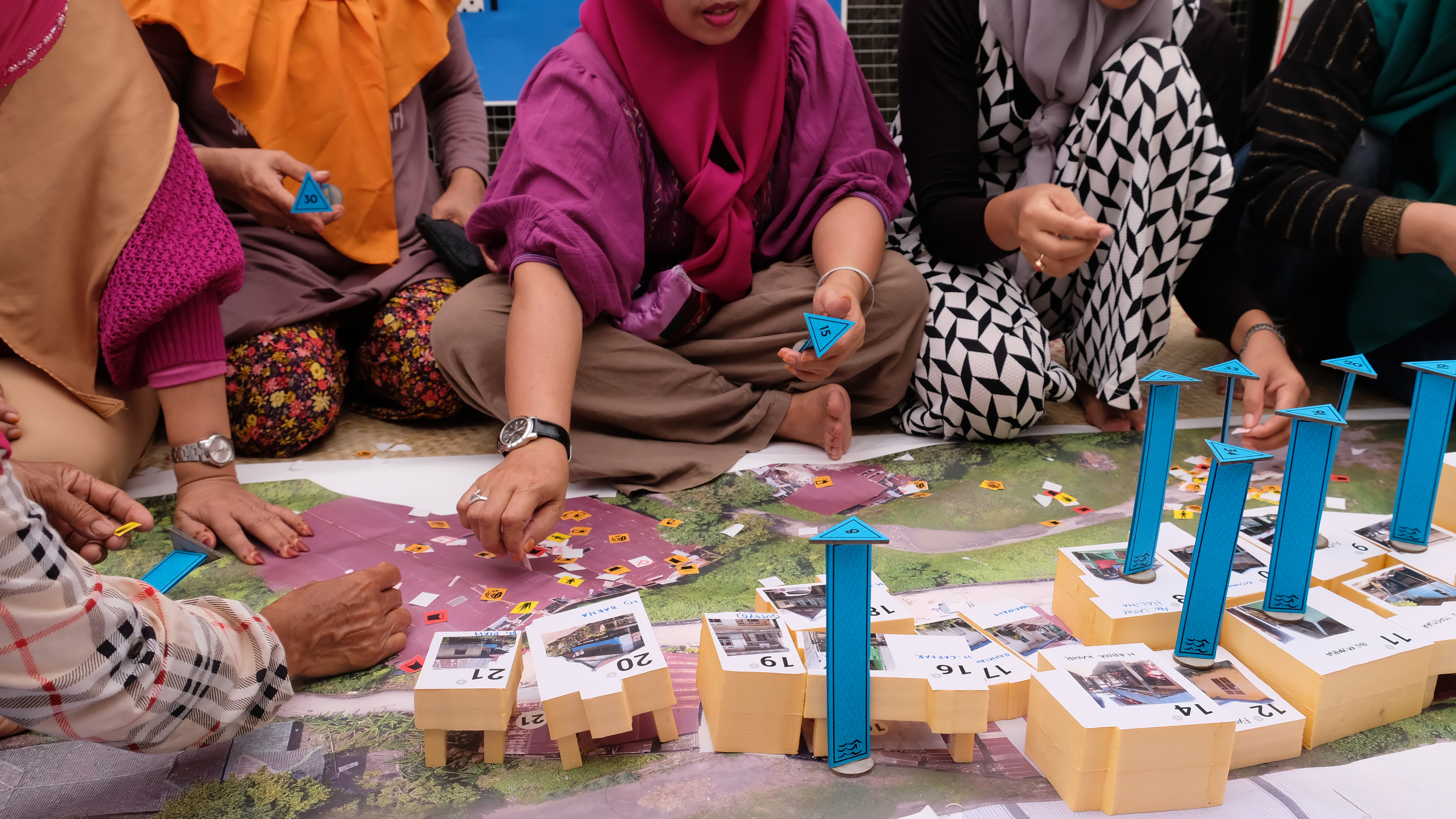
The RISE co-design process with women in Makassar, Indonesia.
