Situated Transfers: Coordinating water-sensitive in-situ upgrading with inhabitant-led housing development in Indonesian urban kampung
Read: PhD thesis by Dr Brendan Josey, Monash University, Faculty of Art, Design and Architecture

Summary
By Dr Brendan Josey
A significant proportion of the global population currently resides in cities and urban areas, and in developing countries up to 50 per cent of the population live in informal settlements. The conditions surrounding, contributing to, and emerging from, informality are increasingly being recognised as important components of sustainable urbanisation.
My research examines the intersections between resident-led housing development, and water-sensitive upgrading in urban informal settlements (kampung) participating in the RISE program in Makassar, Indonesia.
Existing studies on the physical characteristics of resident-led housing development are relatively few. While existing studies provide an excellent basis for categorising the different types of housing adaptation, they do not explore how this gradual growth interacts with infrastructure upgrading, or provide insight into the rate of change that occurs during a project’s design and implementation.
To address this gap, my research examines how ‘top-down’ water-sensitive revitalisation interventions are best coordinated with ‘bottom-up’ resident-led housing development processes. In doing so, it asks three questions that examine:
1) The existing physical dwelling conditions in six RISE kampung,
2) Patterns of resident-led dwelling changes over the course of RISE’s design of infrastructure, and
3) The interactions between resident-led development processes identified by the study, and the proposed RISE water-sensitive intervention.
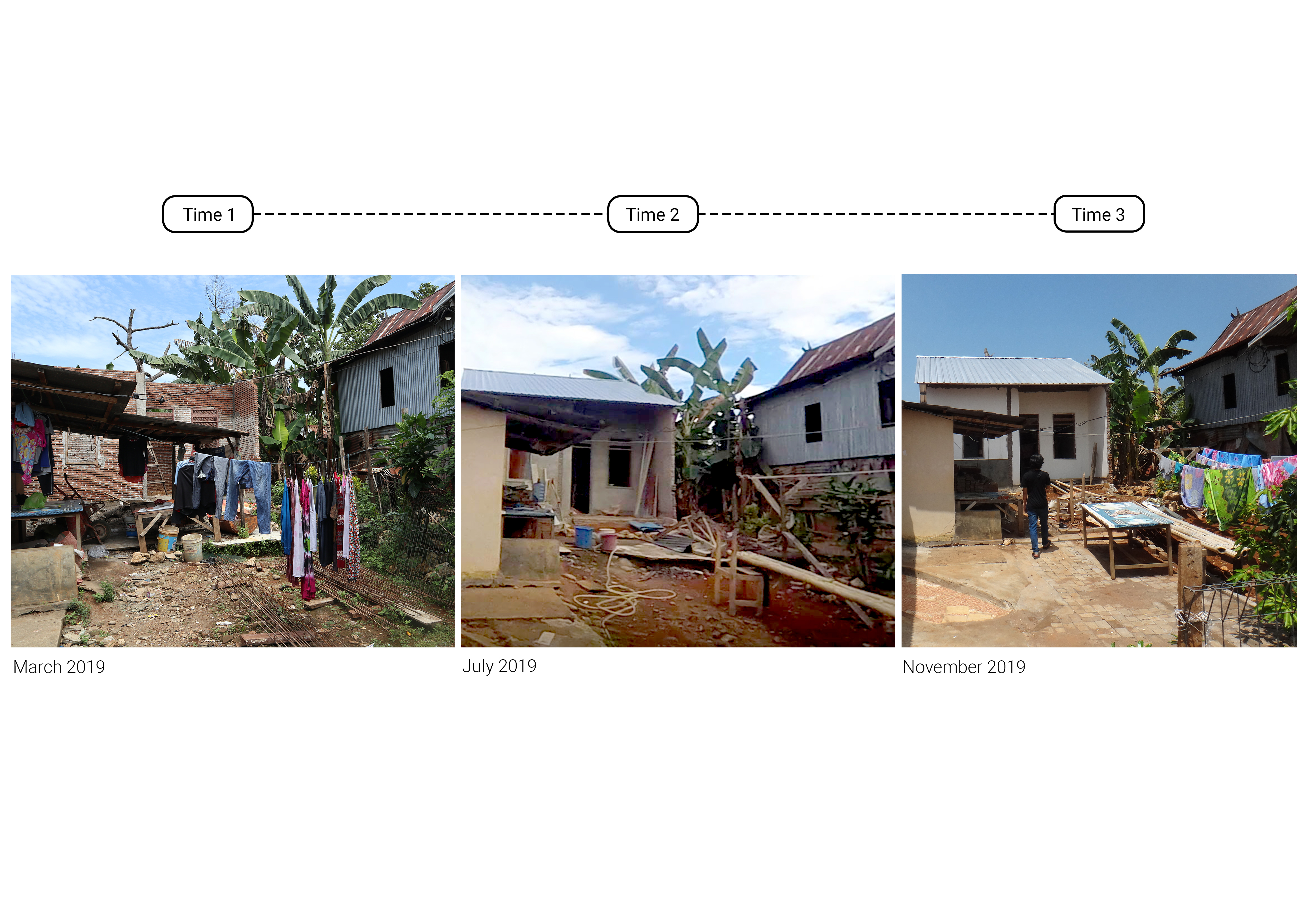
My study employs repeat photography of the built environment to build a dataset of resident-led change between March and November 2019, and from this I analyse resident-led housing changes against the proposed RISE infrastructure intervention.
My study finds that 42 per cent of dwellings in the RISE kampung that were studied in my thesis demonstrated resident-led change over the study period, and 32 per cent of dwellings that changed overlap with RISE’s planned infrastructure works.
These findings show the importance of coordinating resident-led development with in-situ upgrading, and the potential this can have for improved water-sensitive project outcomes.
My study proposes a practical framework with strategies to manage, plan for, and incorporate resident-led development into prospective in-situ upgrading projects. My research reveals ways in which resident-led kampung development (including incremental dwelling additions, adaptations, and ad-hoc infrastructure construction) interacts with the design and planned implementation of the RISE infrastructure. It provides an evidence base to strengthen decision-making for in-situ revitalisation interventions, and to support strategic thinking for future resident-led adaptation in Indonesian kampung.
Below: dwelling development in Makassar, Indonesia, 2019.